Six Days A Week
How Karnataka Put Eggs on The School Menu, Six Days A Week
Awareness campaigns and pilot programmes have seen more students opt for eggs in their midday meal, with the state govt doubling down on evidence linking it to stronger health and nutrition outcomes
West Bengal’s move to exclude eggs from midday meals has revived a familiar debate over nutrition, food choice, and religious sensitivities. Karnataka’s experience, however, shows that the issue need not be reduced to a simple eggs-versus-vegetarian-food binary.
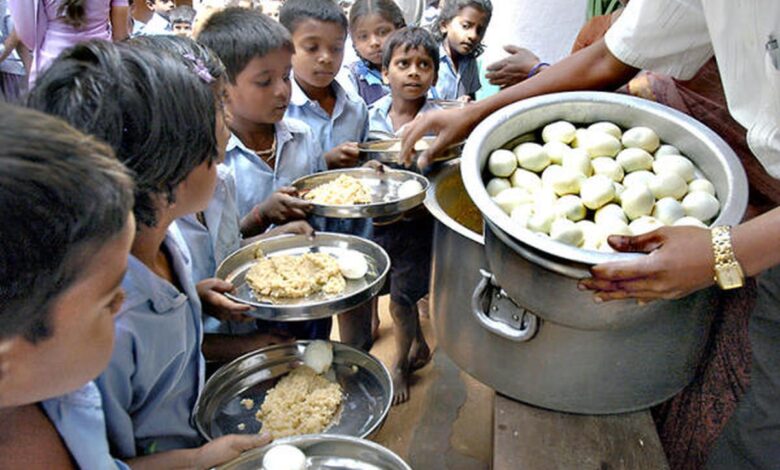
After years of political opposition, objections from religious groups and administrative hurdles, eggs have become a regular part of school meals in Karnataka. Around 65% of the 47 lakh children enrolled in government and aided schools now opt for eggs, while the rest are offered bananas.
The proportion choosing eggs was about 50% in September 2024, but has risen since eggs began to be served on all six school days instead of twice a week.
Getting the Message Across
Officials in the school education department attribute the rise in egg consumption partly to campaigns explaining their nutritional value. Videos, posters and other awareness materials are regularly circulated in schools, while officials have also been asked to engage directly with parents in areas where uptake remains low.
“The biggest challenge continues to be resistance from certain communities due to caste practices, religious beliefs and festival-related customs. Food habits are deeply rooted in culture, so participation cannot be forced. Our role is only to create awareness. We hope egg consumption will rise to 80–85% by next year,” said a senior official in the department.
The programme remains voluntary. Schools serve eggs only after obtaining written consent from parents, and children who do not eat them are offered alternatives.
A Pilot Born of a Crisis
The turning point came in December 2021, when eggs were introduced under a nutrition initiative to tackle malnutrition.
Seven Karnataka districts qualified for the intervention. The proportion of children affected by malnutrition and anaemia in those districts ranged from 68% (Vijayapura) to 74% (Yadgir).
The pilot covered 1.44 lakh students from Classes I to VIII.
The programme cost roughly ₹40 crore, of which the Centre bore nearly ₹6 crore.
Eggs were provided four months at ₹6 per child on two days each month.
Schools also monitored children’s height and weight.
Despite initial opposition from some religious leaders and mutts, the BJP government allowed the pilot to continue.
Evidence Shifts the Debate
The Karnataka State Rural Development and Panchayat Raj University studied 9,000 children in 60 schools.
Half the schools were in Yadgir, where children received eggs or bananas, while the remaining schools were in Gadag, where eggs were not served.
Among girls in Yadgir:
- Weight gain: 0.9 kg
- Height increase: 3.6 cm
Among boys:
- Weight gain: 1.7 kg
- Height increase: up to 7 kg more than counterparts (OCR contains minor error)
The school education department also reported a 6.7% rise in attendance in schools where eggs were served.
More than 91% of children preferred eggs, while the rest chose bananas or chikki (peanut brittle).
Encouraged by these findings, the Basavaraj Bommai-led BJP government expanded the programme to all districts in July 2022, providing eggs twice a week under the PM Poshan scheme.
The programme was expanded again in 2024 under the Congress government led by Siddaramaiah, with eggs being served on all six school days.
The expansion was supported by a ₹1,500 crore grant from the Azim Premji Foundation, funding the additional four days for three years.
Expansion Brings New Issues
The increase in egg distribution also exposed weaknesses.
Many areas depend on NGOs to supply midday meals.
Some NGOs do not serve eggs, forcing schools to:
- identify vendors,
- procure eggs,
- ensure cooking and distribution.
Government reimbursement stands at ₹6 per egg, although actual market prices are often higher, requiring schools to bear the additional cost.
A random audit by the Azim Premji Foundation found that 560 of 762 sampled schools were not serving eggs every day, despite the six-day mandate.
Resistance also persists.
Some children have left schools after eggs were introduced.
Eleven schools in Dakshina Kannada said they could not serve eggs because they operate on temple premises or religious institutions.
Acceptance, But No Certainty
Educationist V.P. Niranjanaradhya said:
“The only protein available at a reasonable price is eggs. Other protein sources like almonds and cashews are far more expensive. Eggs remain the only feasible solution.”
He urged future governments to continue the programme irrespective of political changes.
Public health specialist Dr. Sylvia Karpagam questioned why schools must separately procure eggs instead of meal providers supplying them directly.
She also noted that teachers are increasingly reluctant to handle procurement and cooking responsibilities.
A Question of Choice
Research by Azim Premji University supports including eggs in school meals because they are:
- nutritionally valuable,
- affordable,
- easy to supply at scale.
Economist Dipa Sinha said:
“Vegetarians should be given alternatives, but those willing should receive eggs.”
Karnataka’s model allows both:
- Eggs for children who choose them.
- Vegetarian alternatives for those who do not.
Eggs vs the Alternatives
| Food | Comparable Portion | Protein |
| Egg | 1 large egg (50 g) | 6.3 g |
| Banana | 100 g edible portion | 1.1 g |
| Paneer | 30 g | 5.5–6 g |
| Soya Chunks | 25 g dry | 12–13 g |
13 States/UTs Provide Eggs in Midday Meal
The map highlights that 13 Indian States and Union Territories provide eggs under their school midday meal programmes, with frequency varying by state.
Bengal’s Move Challenged in HC
In his June budget speech, West Bengal Finance Minister Swapan Dasgupta announced that cooked vegetarian meals (including soya, rajma and paneer) would replace eggs in schools run by the Kolkata Municipal Corporation.
ISKCON opposed serving eggs and advocated vegetarian alternatives.
The decision sparked debate over nutrition, food choice and the role of religious beliefs in public policy.