COCCIDIOSIS CONTROL THROUGH PHYTOCHEMICAL MODULATION OF IMMUNITY
BY- CHANDRA SEKHAR GUDLA
INTRODUCTION
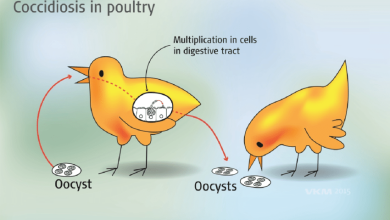
Coccidiosis is a protozoan enteric disease of livestock and poultry caused by a family of monoxenous intracellular parasites targeting the intestinal epithelium (Bhatia, 2016). Being enterotropic protozoa, it disrupts the intestinal mucosa (causing shortening of villi, inflammation and hemorrhage), underlying connective tissue (causing leakage) and alters the gut microbiome leading to dehydration, weight loss, low feed conversion efficiency, increased susceptibility to secondary infections and death (Anthony Andrews, 2024). Coccidian infection has been found to impair mucous formation by causing hypoplasia of goblet cells (Dkhil, 2013) and suppress genes responsible for mucin production and replenishment (Jiang, 2013). Damage to the tight junctions of the mucosa alters the permeability leading to leakage of fluids and crossing of harmful substances into the blood stream. Tight junctions, essential for selective permeability of intestinal epithelium, are disrupted in Eimeria infection (Farid, 2008), causing barrier leakage.
Following the exposure to developing schizonts, innate immunity is developed in hosts body (Quiroz-Castañeda et al., 2015). Macrophages are first responders which engulf the sporozoites. NK cells kill the infected or abnormal cells. Adaptive immunity involves T cells, B cells and macrophages (Min et al., 2013). It is mainly regulated by T cells and associated cytokines. Interleukin 1 and interferon gamma promote Th1 response promoting inflammation thus involved in immune regulation of primary coccidiosis (Breed et al., 1997). Interleukin 4 primarily promotes Th2 response which suppresses Th1 response and supports antibody production. Interleukin 10 and TGF beta promotes T regulatory response which as per studies suppresses excessive inflammation and helps to maintain intestinal balance. Excessive Th1 response leads to severe inflammation and tissue damage (Lal et al., 2009). Increased Th2 and T regulatory responses suppress with the hosts ability to clear the infection as depicted in figure 2. Eimeria has developed mechanisms to exploit the regulatory pathways and ensure its survival (Kim et al., 2019) depicted in figure 3, which can be supported from the studies showing suppression of interferon gamma in post 4-day infection of Eimeria maxima, Eimeria tenella and Eimeria acervulina by (Cornelissen et al., 2009) and decreased CD4+ T cells and increase in T regulatory cells (Walston et al., 2016). Therefore, effective strategies are required to maintain proper immunity without damaging the host tissues.
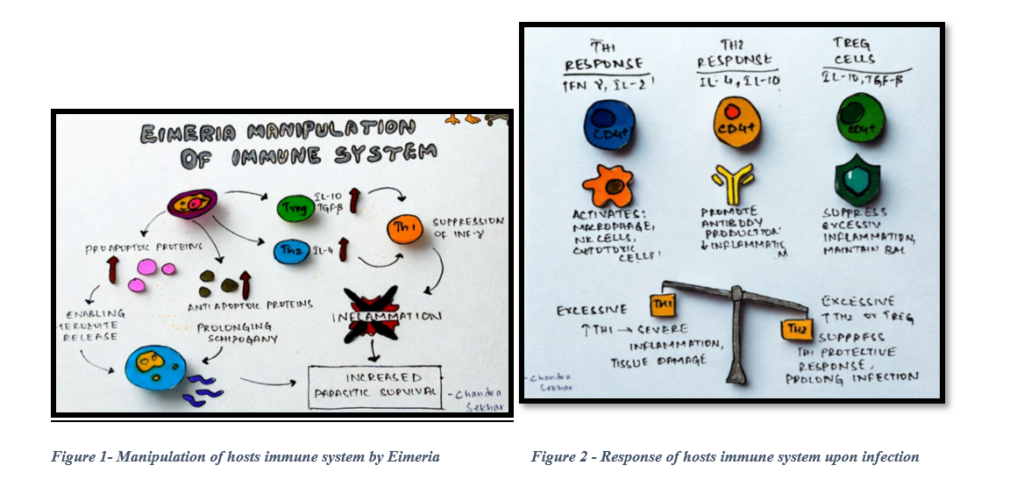
TREATMENT OF COCCIDIOSIS USING PHTYOCHEMICALS:
Anticoccidial drugs, even though are cost effective and successful in elimination of parasite due to increasing drug resistance and public demand of residual free products are facing limitations (Chapman et al., 2010). Plant derived phytochemicals can be used as a better alternative. Studies have shown that dietary supplementation with single or a mixture of selected phytochemicals in young poultry showed direct and indirect beneficial effects on growth performance, intestinal immune response and altered intestinal microbiome in broiler chicken infected with Eimeria species (Gadde et al., 2017). There are a large number of phytochemicals like phenolics, polyacetylenes, alkaloids, polysaccharides, terpenoids produced by plants with numerous bioactive compounds and can intervene in multiple disease signaling pathways (Chang et al., 2013).
Phytochemicals intervening with developmental stages of Eimeria species
Phytochemicals interfere with key developmental stages of Eimeria spp. Artemisia annua (artemisinin) inhibits sporulation and cell wall formation via ROS-induced oxidative stress (Allen, 1997). Tannin-rich pine bark penetrates the oocyst wall and inactivates sporulation enzymes in E. tenella, E. acervulina, and E. maxima, with similar effects reported for selenium and green tea polyphenols (Molan, 2009; Jang, 2007).
Guar bean (saponins, betaine) disrupts membrane sterols, inducing vacuolation, sporocyst damage, and mitochondrial dysfunction (Hassan, 2008; Saladino, 2022; Peng, 2021). Papain from Carica papaya destroys Eimeria proteolytically (AL-Fifi, 2007), while tannins from sorghum and legumes impair energy generation, leading to zygote necrosis and reduced oocyst output (Hur, 2005; Choi, 2022).
Phytochemicals modulating the immune responses of the host
Oriental plum fruit powder rich in phenolic compounds significantly decreased Eimeria acervulina infection by suppressing interferon gamma, interleukin 15, and solenocyte proliferation, thereby enhancing immunity (Lee, 2008). Oats-derived β-glucans improved macrophage activity, antibody, and T cell responses while reducing oocyst shedding (Yun, 2003). Flavonoids from Mangifera indica reduced intestinal lipid peroxidation, decreasing severity of coccidiosis (El-Ghareeb, 2023).
CASE STUDIES: TREATMENT OF COCCIDIOSIS USING PHYTOCHEMICALS
Several plant-derived interventions have demonstrated anticoccidial efficacy across experimental models. Tamarind seed coat powder (5 g/kg BW for 4 days) in naturally infected Tellichery goats cured diarrhea within 2 days and achieved full recovery by 12 days, outperforming sulphadimidine (Soundararajan et al., 2019).
In vitro, essential oils (basil, garlic, oregano, thyme) and their components (carvacrol, thymol) reduced E. tenella invasion (36–55%) and downregulated pro-inflammatory cytokines (IL-8; carvacrol also reduced IL-1β and IL-6) (Felici et al., 2023). Yucca saponin and fenugreek were less protective than salinomycin in chickens challenged with E. tenella, but useful in mild infections and withdrawal phases due to lack of residues (Youssef et al., 2021).
Dietary tannic acid (500–2750 mg/kg) improved gut integrity and nutrient digestibility in E. maxima-infected broilers (Choi et al., 2022). Artemisinin (5–500 ppm) reduced oocyst shedding across Eimeria spp., with 5 ppm improving performance and 500 ppm inhibiting sporulation (Loredana Pop et al., 2015). A cinnamon oil–green tea–pomegranate blend (50–100 mg/kg) increased body weight by 7.5–15% post-E. maxima infection (Inkyung Park et al., 2023). Additionally, Capsicum annuum (0.3%) reduced oocysts (Lozada-Ortiz et al., 2022), while Curcuma longa (1 g/kg paste) eliminated fecal oocysts within two weeks (Favour et al., 2020).
PLANTS EVALUATED FOR THEIR POTENTIAL ROLE IN THE TREATMENT OF COCCIDIOSIS THROUGH IMMUNOMODULATION
Several plant-based interventions have been evaluated for their immunomodulatory role in coccidiosis management. Lawsonia inermis powder (40 g/kg) in mixed Eimeria infection reduced IL-10 while increasing IL-4 and TNF-α, indicating anti-inflammatory and antioxidant enhancement (Eldeeb et al., 2025). Carica papaya (15 g/kg feed) elevated serum IgY levels in E. tenella infection, suggesting humoral immunomodulation (Hadimani et al., 2011). A mixture of capsicum oleoresin (4 mg/kg) and turmeric oleoresin (4 mg/kg) increased lymphocytes, IL-6, and IFN-γ in E. tenella challenge (Leea et al., 2011).
Azadirachta indica (400 mg/kg BW) demonstrated anti-anemic effects and reduced inflammation in mixed infections (Gotep et al., 2016), while betaine from Beta vulgaris (1000 ppm) altered osmoregulation in duodenal cells (Kettunen et al., 2001). A VAC mixture (carvacrol 5 mg/kg, cinnamaldehyde 3 mg/kg, capsicum oleoresin 2 mg/kg) enhanced K⁺ macrophage activity against E. tenella (Leea et al., 2011).
Carthamus tinctorius (200 mg/kg) reduced inflammatory cytokine production in E. acervulina infection (Choi et al., 2009). Artemisia brevifolia (300 mg/kg) improved cell-mediated response and antibody levels in mixed infection (Hussain et al., 2023). Similarly, Ficus religiosa (10 & 50 g) elevated lymphoblastogenic responses, increased total, IgG, and IgM antibody titers, and reduced gut lesions (Mumtaz et al., 2021).
CONCLUSION
Taken together all the above studies and numerous other reports and investigations, show that phytochemicals hold significant promise as alternatives to synthetic drugs in the control of coccidiosis, particularly through their ability to modulate host immune responses and also serving as prebiotics improving the conditions of gut microbiome. However, uncertainties remain regarding dosage, efficacy, and toxicity relationship, along with challenges of changing compositions of constituents across geographical regions and variable in vitro and in vivo responses to treatment, making them difficult to standardize. Deeper studies on their mechanisms are essential. With proper research and development, herbal-based therapeutics can emerge as reliable, safe, and sustainable tools for managing coccidiosis in poultry production.
ACKNOWLEDGEMENTS
I sincerely acknowledge Dr. Annu Yadav (M.V. Sc in VMD, Ph. D- LUVAS) for her guidance and support, which greatly helped me in completing this article successfully.