Global Poultry Market
The Strategic Importance of the Global Poultry Market
Prof. (Dr.) P.K. Shukla and Dr. Amitav Bhattacharyya
Department of Poultry Science,
College of Veterinary Science and Animal Husbandry, Mathura- 281001 (U.P.)
Introduction
The global poultry market constitutes one of the most rapidly expanding and strategically important segments of the international agri-food system. Poultry meat and eggs have become central to global food and nutrition security due to their affordability, high biological value, and widespread cultural acceptability. Unlike other livestock commodities, poultry products face minimal religious or cultural restrictions, enabling universal market penetration. Over the last four decades, the poultry sector has demonstrated remarkable growth, outpacing beef, pork, and small ruminant sectors in terms of production volume, technological adoption, and global trade integration. According to international estimates, poultry now contributes more than 40 percent of total global meat production growth, reflecting its superior feed efficiency, shorter production cycles, and adaptability to diverse agro-climatic conditions.
The strategic importance of poultry is further amplified by its role in employment generation, income diversification, and rural development, particularly in low- and middle-income countries. Smallholder poultry production supports livelihoods for millions of households, while vertically integrated commercial systems supply urban and export markets. However, the sector’s rapid expansion has also brought to the forefront a complex set of challenges related to disease emergence, feed resource competition, environmental sustainability, and market volatility. Globalization has interconnected poultry markets across continents, making the sector increasingly sensitive to trade policies, sanitary regulations, and geopolitical disruptions. An academic examination of the global poultry market must therefore assess both the opportunities that drive growth and the structural challenges that threaten long-term resilience.
Global Production and Consumption Trends
Global poultry production has expanded consistently, driven by population growth, urbanization, and rising incomes. Asia remains the largest producer and consumer of poultry products, with China and India playing dominant roles due to their population size and expanding middle class. The Americas, particularly the United States and Brazil, are characterized by highly industrialized, export-oriented production systems that benefit from economies of scale, advanced genetics, and strong feed grain availability. Europe maintains a balanced profile, with high per capita consumption and strong regulatory oversight emphasizing food safety and animal welfare.
Consumption trends reveal a global shift toward poultry meat as a preferred source of animal protein. Poultry is often perceived as healthier than red meat due to its lower fat content and favourable fatty acid profile. In developed economies, per capita consumption has reached saturation levels, prompting demand for differentiated products such as organic, antibiotic-free, and welfare-certified poultry. In contrast, developing economies exhibit strong growth potential as poultry consumption increases from low baseline levels. Egg consumption has also grown steadily, supported by recognition of eggs as an affordable, nutrient-dense food. Despite overall expansion, disparities in consumption persist across regions, reflecting income inequality, infrastructure limitations, and dietary preferences.
International Trade and Market Integration
International trade plays a pivotal role in shaping the global poultry market, facilitating the movement of products from surplus to deficit regions. A limited number of countries dominate global exports, with Brazil, the United States, the European Union, and Thailand accounting for a substantial share. These exporters benefit from integrated value chains, stringent quality control systems, and compliance with international sanitary and phytosanitary standards. Import-dependent regions include the Middle East, Sub-Saharan Africa, and parts of East Asia, where domestic production is constrained by feed availability, climatic factors, or policy limitations.
Poultry trade is uniquely sensitive to animal health events. Outbreaks of avian influenza often result in immediate import bans, disrupting trade flows and causing significant economic losses. Geopolitical tensions, trade disputes, and changes in tariff regimes further contribute to uncertainty. At the same time, globalization has improved efficiency, enabled product specialization, and expanded consumer choice. The challenge lies in balancing open trade with robust biosecurity and risk management frameworks to ensure continuity and stability in global poultry markets.
Technological Innovations and Productivity Gains
Technological progress has been a major driver of productivity gains in the global poultry industry. Genetic selection has resulted in broiler strains with rapid growth rates and improved feed conversion ratios, as well as layer strains with higher egg production and persistence. Advances in nutrition science have optimized feed formulations, incorporating enzymes, amino acid balancing, and precision feeding techniques to enhance efficiency and reduce waste. Automation and digitalization have transformed poultry housing and management, enabling real-time monitoring of environmental conditions, bird health, and performance parameters.
Processing and value addition technologies have also evolved significantly, supporting the growth of ready-to-cook and ready-to-eat poultry products. Cold chain infrastructure and improved packaging have extended shelf life and facilitated long-distance trade. However, access to advanced technologies remains uneven, particularly in developing countries where smallholders often lack capital and technical capacity. Addressing this technology divide through targeted investments and capacity-building initiatives represents a critical opportunity for inclusive sectoral growth.
Opportunities in Emerging and Developing Economies
Emerging and developing economies represent the most significant growth frontier for the global poultry market. Rapid population growth, urban expansion, and dietary diversification are driving strong demand for affordable animal protein. Poultry’s short production cycle and relatively low entry barriers make it an attractive enterprise for small and medium-scale farmers. In regions such as South Asia, Southeast Asia, and Africa, poultry often serves as a primary source of household income and nutritional security.
The expansion of organized retail, food service industries, and e-commerce platforms has further stimulated demand for standardized and processed poultry products. Governments and development agencies increasingly recognize poultry as a tool for poverty reduction, gender empowerment, and youth employment. With appropriate policy support, infrastructure development, and access to finance, developing countries can harness poultry sector growth to achieve broader socio-economic objectives.
Feed Resource Constraints and Cost Volatility
Feed costs account for the largest share of poultry production expenses, typically ranging from 60 to 70 percent of total costs. The global poultry industry is heavily dependent on maize and soybean meal, linking poultry economics closely to global grain markets. Climate change, biofuel policies, and geopolitical disruptions have intensified price volatility, posing significant challenges to profitability and price stability.
To mitigate feed-related risks, the industry is exploring alternative feed ingredients such as distillers dried grains with solubles, oilseed by-products, and novel protein sources. While these alternatives offer cost-saving potential, issues related to nutrient variability, quality assurance, and regulatory acceptance persist. Ensuring sustainable and affordable feed supplies is therefore a central challenge for the long-term competitiveness of the global poultry sector.
Animal Health, Biosecurity, and Disease Challenges
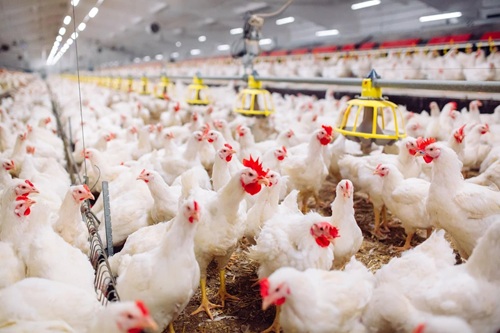
Animal health is a critical determinant of productivity and market access in the global poultry industry. Transboundary diseases, particularly highly pathogenic avian influenza, pose recurrent threats to production, trade, and consumer confidence. Intensification and high stocking densities can exacerbate disease transmission if biosecurity measures are inadequate. Additionally, antimicrobial resistance has emerged as a global concern, prompting stricter regulations on antibiotic use in poultry production.
The industry is increasingly shifting toward preventive health strategies, including vaccination, enhanced biosecurity, and improved management practices. Strengthening veterinary services, disease surveillance, and early warning systems is essential, particularly in developing regions. Effective animal health governance not only protects poultry production but also safeguards public health and international trade relationships.
Sustainability, Environment, and Animal Welfare Concerns
Sustainability considerations are becoming central to the global poultry market. Although poultry has a lower environmental footprint compared to ruminant livestock, large-scale production raises concerns related to waste management, greenhouse gas emissions, and water use. Regulatory and consumer pressures are driving the adoption of environmentally responsible practices, including improved manure management, resource-efficient housing systems, and renewable energy use.
Animal welfare has also emerged as a key issue, particularly in developed markets. Demand for cage-free eggs and higher welfare standards is influencing production systems and investment decisions. Balancing economic efficiency with environmental and ethical considerations represents both a challenge and an opportunity for innovation and market differentiation.
Policy, Regulation, and Market Governance
Policy frameworks and regulatory environments play a decisive role in shaping global poultry market outcomes. Trade policies, food safety regulations, disease control measures, and animal welfare standards directly influence competitiveness and market access. In many countries, fragmented or inconsistent regulations create inefficiencies and uncertainty for producers and investors.
International organizations and trade agreements increasingly emphasize harmonization of standards, transparency, and science-based decision-making. Public–private partnerships are essential to address systemic challenges and align industry growth with societal expectations. Effective governance can enhance resilience, promote innovation, and ensure equitable participation across the poultry value chain.
Future Outlook: Balancing Growth with Resilience
The global poultry market is poised for continued expansion, supported by strong demand fundamentals and ongoing technological progress. However, sustaining this growth will require proactive management of interconnected challenges related to feed security, disease risks, environmental impact, and market volatility. Opportunities lie in diversification, value addition, digital transformation, and inclusive business models that integrate smallholders into modern value chains.
Building resilience through innovation, policy coherence, and international cooperation will be critical in an increasingly uncertain global environment. As the world seeks affordable, nutritious, and sustainable protein sources, the poultry sector will remain central to global food systems, provided it adapts effectively to evolving economic, environmental, and social expectations.