Microbiome on Poultry Health
Interaction of Microbiome on Poultry Health and Production
Prof(Dr) R.N.Sreenivas Gowda
Introduction
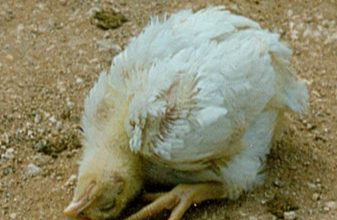
The microbiome is the entire community of microorganisms (bacteria, fungi, viruses, etc.) and their genetic material living in a specific environment, most notably on and within the bird’s body (gut, skin, mouth) but also in soil, water, and plants, forming complex ecosystems crucial for health, digestion, immunity, and production. Some of these organisms(Pathogens) cause severe infections causing heavy mortality in flocks.
This article highlights the crucial influence of the farm microbiome on poultry health, immunity, and production performance
In poultry farming, there are two types of microbiome called as on Poultry Farm microbiome and Bird microbiome. Although both live in hormoney but, if one exceeds it will alter both health and production.
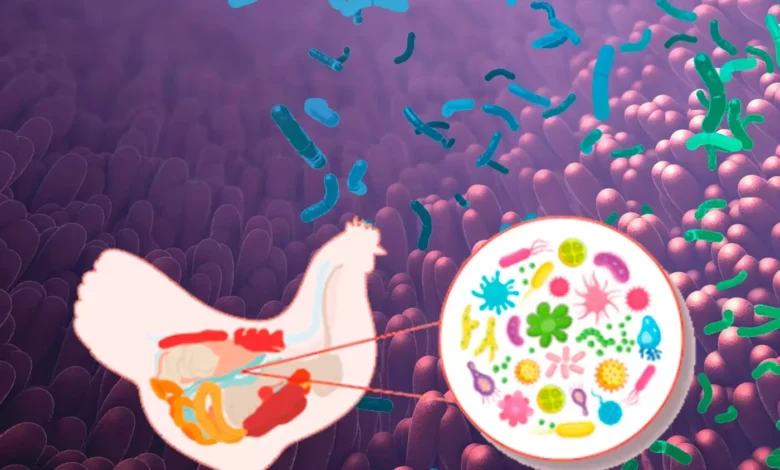
The poultry farm microbiome refers to the complex community of microorganisms—including bacteria, viruses, fungi, protozoa, and archaea—that inhabit individual birds and the environment they live in. It is often described as a “dynamic proto-organ” that fundamentally influences bird health, growth, and resistance to infection.
Environmental Microbiome: Includes microorganisms found in litter (bedding), farm dust, soil, and water. Litter acts as a major reservoir for microbial exchange; birds constantly ingest litter particles, which helps shape their internal gut flora. In older poultry farms with limited biosecurity, the organisms multiply and cause “bacterial blooms” often ends with disease outbreaks with severe mortality.
Microbiome Sources
Environmental Sources: Newly hatched chicks acquire their initial microbiome from farm soil, air, water, and bedding material (litter).
- Litter Management:Reused litter can increase beneficial butyrate-producing bacteria like Faecalibacterium prausnitzii in young chicks, though it requires strict management to avoid pathogen carryover.
Production Systems:
- Conventional:Often has lower microbial diversity due to antibiotic use, which selects for specific resistant taxa.
- Alternative (Organic/Free-Range):Generally, exhibits higher microbial diversity due to outdoor access and exposure to a wider range of environmental microbes, which can enhance disease resilience but may increase exposure to wild-vector pathogens.
- Key Components of the Microbiome
The microbiome exists in several distinct niches across the farm:
- Gut Microbiome:The most diverse and densely populated area, particularly in the caecum (large intestine), where bacteria reach concentrations of 10¹¹ cells per gram.
- Exterior Microbiome:Unique microbial communities on the skin and feathers, which are primarily aerobic due to oxygen exposure.
- Common Microorganisms
While thousands of species exist, a few phyla dominate the poultry microbiome:
- Bacteria:Predominantly Firmicutes (e.g., Lactobacillus, Clostridium), Bacteroidetes (e.g., Bacteroides), and Proteobacteria (e.g., Escherichia, Salmonella, Campylobacter).
- Pathogens:Notable members include zoonotic bacteria like Salmonella and Campylobacter, which can colonize birds without causing them harm but pose significant food safety risks to humans.
- Fungi:Often called the “mycobiome,” common genera include Candida, Penicillium, and Aspergillus.
- Essential Functions of Microbiome
A healthy, balanced microbiome (homeostasis) provides critical benefits to the bird:
- The farm microbiome is a critical “functional organ” that determines poultry health, immunity, and overall production efficiency.
- Nutrient Digestion: Microbes ferment indigestible carbohydrates into short-chain fatty acids (SCFAs) like butyrate, which serve as an energy source for the host.
- Immune System “Training”: Early exposure to microbes is vital for the development of the bird’s adaptive and innate immune systems.
- Competitive Exclusion: Beneficial “commensal” microbes take up space and resources, preventing pathogenic bacteria from colonizing the gut.
- Role in Poultry Health and Immunity
- Immune System Training:Early microbial colonization is essential for maturing the gut-associated lymphoid tissue (GALT). Beneficial microbes stimulate the production of antibodies (IgA, IgG) and activate cytokines that modulate both innate and adaptive immune responses.
- Pathogen Protection:Commensal bacteria (e.g., Lactobacillus, Bifidobacterium, Faecalibacterium) protect birds through competitive exclusion, occupying niches and producing antimicrobial compounds like bacteriocins and short-chain fatty acids (SCFAs) that inhibit pathogens such as Salmonella, Campylobacter, and Clostridium perfringens.
- Gut Integrity:A healthy microbiome maintains the intestinal barrier, increasing villus height and strengthening tight junctions, which prevents the translocation of harmful toxins and bacteria into the bloodstream.
- Role in Production and Performance
- Nutrient Digestion:Microbes break down complex polysaccharides (fibers) that the bird cannot digest on its own, releasing energy in the form of SCFAs (e.g., butyrate).
- Vitamin Synthesis:The microbiome synthesizes essential vitamins, including Vitamin K and several B vitamins (e.g., biotin, riboflavin, thiamine), supporting overall metabolic health.
- Growth Efficiency:High microbial diversity is often linked to improved Feed Conversion Ratio (FCR) and Body Weight Gain (BWG). Specifically, the presence of Faecalibacterium and Bacteroides is positively correlated with high-performing flocks.
- Egg Production:In layers, a balanced microbiome improves egg production rates, eggshell quality, and Haugh units (a measure of freshness).
Factors Influencing the Farm Microbiome
- Modulation Strategies:Producers use probiotics, prebiotics, and in-ovo feeding (administering beneficial microbes into the egg) to establish a healthy microbiome early, especially in the absence of maternal contact in commercial hatcheries
- Age: The microbiome undergoes “succession”; it is initially dominated by Enterobacteriaceae and shifts toward Firmicutes as the bird matures, usually stabilizing by week three.
- Production System: Conventional farms (which may use antibiotics) often have lower microbial diversity compared to organic or free-range systems, where birds have greater exposure to environmental microbes.
- Diet: Changes in feed (e.g., switching from starter to finisher diets) or the addition of probiotics and prebiotics directly alter microbial populations.
- Environment: Temperature, humidity, and biosecurity practices (like litter management) are major external determinants.
- Microbiome analysis in poultry production is a critical tool for optimizing bird health, improving production efficiency, and ensuring food safety. By leveraging advanced sequencing technologies, producers can move beyond traditional culture-based methods to understand the complex microbial communities that directly influence nearly every stage of a bird’s life and the processing chain.
1.Enhancing Production Performance and Feed Efficiency
The gut microbiome is fundamentally linked to how well poultry convert feed into body weight.
- Energy Harvesting:Specific microbial patterns, such as Bacillota-enriched (formerly Firmicutes) communities, are positively correlated with higher feed intake and increased final body weight.
- Metabolic Indicators:Analysis can identify beneficial genera like Butyricicoccus and Faecalibacterium, which produce short-chain fatty acids (SCFAs) that improve feed conversion and energy harvesting efficiency.
- Growth Optimization:High microbiome diversity is generally associated with more stable growth rates and improved European Production Efficiency Factor (EPEF) scores.
- Improving Health and Immune Competence
A balanced microbiome acts as a “second immune system,” providing natural resistance to disease.
- Competitive Exclusion:Analysis helps monitor beneficial bacteria that outcompete pathogens like Salmonella, Campylobacter, and Clostridium perfringens for resources and attachment sites.
- Immune Maturation:Early-life microbiome analysis is essential for identifying the “pioneer colonizers” that stimulate the development of the gut-associated lymphoid tissue (GALT).
- Reducing Antibiotic Reliance:By using microbiome insights to develop effective alternatives like probiotics and prebiotics, producers can reduce the need for routine antimicrobial use.
- Food Safety and Processing Management
Microbiome analysis extends from the farm into the processing facility to mitigate public health risks.
- Pathogen Mapping:“Microbiome mapping” tracks the movement of pathogens and spoilage organisms through the processing plant, helping to identify critical contamination points.
- Predicting Shelf Life:By identifying “specific spoilage organisms” (SSOs) like Pseudomonas or Brochothrix thermosphacta, producers can better predict the quality and shelf life of final meat products.
- Resistome Monitoring:Metagenomic analysis allows for the detection of Antibiotic Resistance Genes (ARGs) and virulence factors within the environment, providing data for more targeted sanitation protocols.
- Precision Management Across Production Systems
Different rearing systems (conventional vs. organic/pasture-raised) produce distinct microbial profiles that require different management strategies.
- Environmental Impact:Analysis of farm litter, soil, and dust helps producers understand how environmental factors like heat stress or bedding type influence the birds’ internal health.
- Customized Interventions:Insights from microbiome data enable the “microbiome engineering” of flocks—tailoring nutritional additives (probiotics, prebiotics, enzymes) to the specific needs of a flock to maintain stability during stressful transitions.
Microbiome Analysis
Why Poultry farm microbiome analysis is Important?
Poultry farm microbiome analysis is the scientific study of the entire community of microorganisms—including bacteria, viruses, fungi, and archaea—along with their genetic material and metabolites, found within poultry and their production environments.
This analysis is important to optimize the bird health, productivity, and food safety by monitoring microbial shifts from the farm to the processing plant.
Influencing Factors: The microbiome composition is highly dynamic and is shaped by the bird’s age, genetics (breed), diet, housing type (indoor vs. free-range), and seasonal environmental stressors like heat or cold.
Key Components of Analysis
- Targeted Areas:Researchers primarily analyze the gastrointestinal tract (especially the cecum for fermentation), but also examine the respiratory tract, reproductive tract, skin/feathers, and environmental sources like litter, soil, waterers, and feeders.
- Primary Technologies:Modern analysis largely depends on 16S rRNA gene sequencing to identify bacterial taxa and shotgun metagenomics for a broader view of all microbes and their functional genes (e.g., antibiotic resistance).
- Measurement Metrics:
- Alpha Diversity:Measures the richness and complexity of microbes within a single sample.
- Beta Diversity:Compares differences in microbial communities between different groups, such as conventional vs. organic farms.
Practical Applications
- Productivity & Growth: Certain “patterns” (e.g., Bacillota-enriched) are positively correlated with higher feed intake and final body weight, while others (e.g., Bacteroidota-dominated) are negatively associated with productivity.
- Disease Management: Identifying imbalances (dysbiosis) helps predict risks for conditions like necrotic enteritis (caused by Clostridium perfringens) or respiratory infections.
- FoodSafety: Tracking pathogens like Salmonella and Campylobacter throughout the “farm-to-fork” continuum allows for better intervention strategies during processing.
- Operational Efficiency: 2025 technology platforms use real-time microbial data to predict optimal downtime between flocks and select specific sanitation protocols, improving feed conversion rates.
- Antibiotic Alternatives: Analysis evaluates the effectiveness of prebiotics, probiotics, and organic acids as replacements for traditional antibiotic growth promoters.
Conclusion
The poultry microbiome is the complex community of microbes (bacteria, fungi, viruses) living in and on chickens, crucial for their digestion, immunity, growth, and overall health, influencing everything from nutrient absorption to disease resistance, and is shaped by diet, environment, and genetics, with research focusing on modulating it (via probiotics, prebiotics) for improved welfare, productivity, and food safety by reducing antibiotics. Key microbes like Lactobacillus and Bacteroides help, while imbalances can lead to issues, with the cecum being a major microbial hub. This analysis is used to optimize bird health, productivity, and food safety by monitoring microbial shifts from the farm to the processing plant.
(*Former and Founder VC, KVAFSU, Bidar. Former Director IAH&VB, Bangalore, Former Prof and University head, Dept. of pathology, Veterinary College UAS Bangalore)